 |
| Flagrant plagiarism!. |
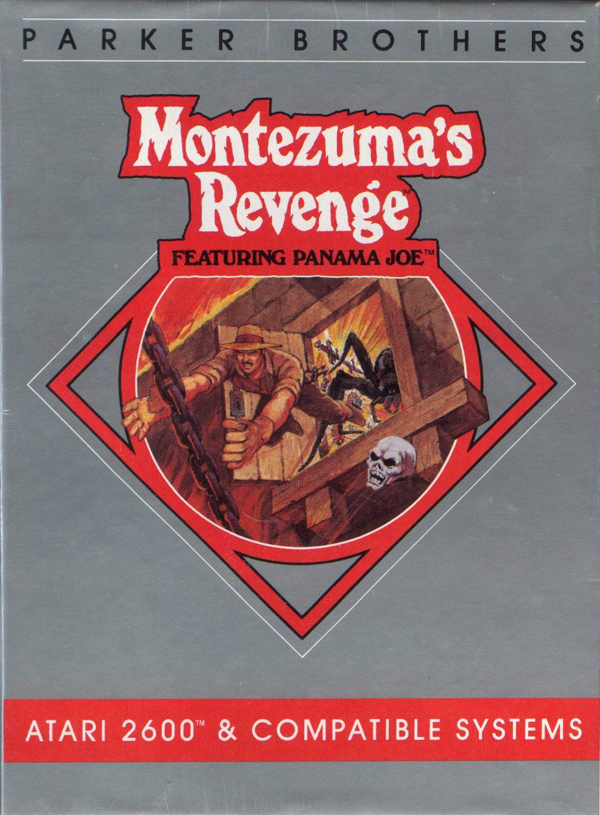
Publisher/Designer: Parker Brothers
Release Date: 1984
Systems (played on): Atari 2600, Atari 5200, Apple II, Atari 8-bit, Commodore 64, ColecoVision, PC Booter, SEGA Master System
I'm going to be honest: I know very little about the Atari 2600. I was born in 1985, and by then the Atari 2600 was already a relic. The graphics were simple, the sound was almost non-existent, and the games were repetitive. Growing up, one of my neighbors had one: we rarely played it, and when we did we focused almost entirely on Combat for its fantastic multiplayer and occasionally took turns with Pitfall before getting bored and going back to NES. So, that out of the way, here's what I know about Montezuma's Revenge:
The game appears to have been released for a number of system, including Commodore 64, PC, Apple II, Atari 2600 and 5200, and the ZX Spectrum starting in 1984. There isn't a lot of information available online, but the manual for the 5200 and C64 release shows a 1984 date, along with a few Atari information sites confirming a 1984 date for the 2600 release. The Wikipedia article provide some brief notes on its development at the hands of 16 year old Robert Jaeger.
My first surprise when researching this game was the array of systems this was ported to: what I thought of as an obscure game was actually widely available. My second surprise was this game was actually pretty fun and surprisingly advanced compared to my conception of Atari 2600 games.
+(Parker+Bros)_2.png) |
| Each hat is a life. You will need all of them. |
Oh, sure, the difficulty is absurd. I barely made it off the first screen in the first few rounds of play. Everything provides a way to die: if you jump from too high off a rope to an adjacent platform, you will die. If you slip off the conveyor belts, you will die. If you touch an enemy, you will die. If you touch a laser, you will die. In retrospect, these are obvious, but modern games have spoiled me.
+(Parker+Bros)_6.png) |
| I really don't think the points are worth it. |
The amount of precise timing in this game is something I'm not used to. You can't tell from the screen shots, but that skull rolls around fast, and those blue lines are laser gates and leave little room for error. Luckily for the player, the protagonist, Panama Joe, is a zippy archaeologist and responds nicely to the controls.
+(Parker+Bros)_7.png) |
| This is how you enter this screen. If you don't stop moving as soon as you come down the ladder, you will be killed by the spider. Super harsh, Montezuma. |
Moving beyond the difficulty, this game certainly offers a lot of options. I've haven't been able to get far in this game: I've mapped a total of 9 screens, over maybe 50-60 lives and an hour. I haven't seen a torch or an amulet yet. According to the manual, with the exception of the torch, all of the items are single use. This is a standard game trope with keys, but is disappointing with the sword. Despite my disappointment at my lack of a more extensive and permanent inventory, I was impressed right away with the branching paths available! Furthermore, the game "remembers" what happened during your life. When you die, you quickly restart on the screen you were on, and enemies stay dead, doors stay opened, etc. I was expecting each death to reset the current screen, but luckily the game isn't that rough on the player.
That concludes the first hour or so of gameplay. I don't have a terrible passion to keep on playing it, but I'll continue to try and see what else it offers.


No comments:
Post a Comment