So, real life has been very busy.
My first child was born at the start of last month, and between my wife's illness, a new child, and family visits, I haven't had any proper time to continue this project. Hopefully, by the end of the month, a normal pace of things will resume.
Saturday, October 6, 2012

Sunday, August 12, 2012
Brain Breaker: Are We Lost Mammals of an Approaching Transcendental Epoch? (with Final Rating)
To put it simply: real life got busy. My first child is due in a couple of weeks, and life is hectic. I haven't had the time to play, let alone write, about a nearly 20 year old Japanese game. Luckily, it's a lazy weekend and I was able to get enough Brain Breaker played to call it quits.
There is a door I can not go through, that leads to a building and elevator higher than the my jet pack lets me fly over. The gate to the building seems to be the same kind of gate that led to a rocket launcher, which was opened using the ID card that I mentioned in the previous post. Trying to use the ID card here does nothing, besides providing Japanese text. Going back to the building with the jet pack, there is a computer there I can use. ID card and Ask both produced Japanese text, but I was still unable to open the door. Likewise, I destroyed the computer with rockets, but the door stayed shut and resistant to my assault. Luckily, I had spent the required time for this game, and decided to move on.
 |
| Moving Pictures & Secret Walls |
It's not that I don't enjoy wandering around a desolate city: in fact, I love that part of the game. I enjoy slowly working my way west across the city, uncovering new monsters and weapons. The combat remains challenging but not too difficult, and while the slow movement speed isn't great, it's not the end of the world. Combat get significantly easier with the introduction of the rocket launcher, which both has a larger spread and can destroy enemy projectiles. However, regardless of these traits, the problem is that I can't read Japanese.
 |
| A Machine and a Memory Keep You Alive |
Looking around online, Hardcore Gaming 101 features the best information I can find on Brain Breaker. The article has a good overview of the game, including information on the ending and progressing further than I did. The author noticed the same problem that I did: the game is completely incomprehensible, and they were only able to complete the game after finding a video of a play through.
Reading through the Hardcore Gaming 101 review, it's clear the game continues to be inscrutable, weird, difficult and obtuse. One notable example is needing to drop and then destroy your laser gun in order to clear a barrier. I'm sorry I didn't finish this game, if nothing else than to gain godlike psionic powers.
With nothing else to say, let's wrap this up and get on with the rating for Brain Breaker.
Visuals. The game looks nice. I don't know enough about the Sharp X1 to comment on technical achievement, but the graphics due a great job of conveying the desolate world of Brain Breaker. The various buildings that litter the landscape are impressively large, and the endless plains to the right of the starting point are appropriately desolate.
 |
| The Fun of Watching Fireworks |
The enemy robots and various objects that litter the landscape are less imposing. The objects are often hard to make out due to their small size, and things like the laser gun were almost completely invisible. 5/10
Audio. The progress has been mixed since Montezuma's Revenge. One one hand, there is music in Brain Breaker! On the other hand, the music consists of a single blippy song that loops endlessly, and the song isn't particularly memorable. Or good. The special effects are in the same vein as Montezuma's Revenge: scratchy garbled noises and an appropriate "pew pew" sound for lasers. 4/10
 |
| Re-Inventing a Challenge for Machines |
Gameplay. Aside from the inscrutable Japanese text, my biggest complaint with this game is how bad the controls are. There is a delay for almost everything, which leads to constant deaths that should be avoided. Simple tasks, like getting out of a small hole, are rendered difficult by the stiff controls.
Combat is difficult due to the controls: I rarely died when I was facing an enemy, but often died because my character did not turn around and shoot before being fired upon. While there is none of the obscene difficulty of Montezuma's Revenge, the stiff controls detract from an otherwise enjoyable game in Brain Breaker. 4/10
Metroidvania Quotient. Like everything else in this game, it's a mixed bag. On one hand, you get new powers that let you explore the map at a better rate, and interesting new weapons that let you easily destroy your foes. Getting the jetpack and then discovering an entirely new level of the map was fantastic. Starting off the game and running into an impassable robot was a nice touch.
 |
| All you are going to want to do is get back there |
On the other hand, everything is entirely mandatory. As far as I can tell from my own playing and the Hardcore Gaming 101 review is that every item is needed for progression. There is no sense of exploring and finding secrets. There isn't even the feeling of a branching path like in Montezuma's Revenge, and there seems no value in replaying it. 4/10
Set and Setting. This is where Brain Breaker really shines: the games desolate cityscape is fantastic, in scope and execution. Buildings tower up far beyond even the reach of the player's jet pack, and broken pieces of technology litter the landscape. The bizarre lay-out gives a truly alien feel to the world of Brain Breaker, with floating platforms hiding secrets and impossibly tall buildings blocking progress. Combined with the varying rate of combat, the world is a beautiful lonely place. 7/10
That leaves Brain Breaker with a score of 22, slightly beating Montezuma's Revenge and leaving plenty of room for improvement! Up next is Citadel for the BBC Micro/Electron, another game and system I know nothing about.
Monday, July 30, 2012
Brain Breaker: Toward a Damaged Horizon
So, ignoring the old-fashioned difficulty, Brain Breaker is turning out to be really intriguing. For one, the backdrop and general setting is fantastic, especially for a game this age. The sparse city has a texture and depth that wasn't found in the minimalist graphics from Montezuma's Revenge. Additionally, as I get further in, the game opens up more and more, and new items become available, and new graphics are unveiled.
It's not easy to tell from the pictures, but the scale of the city is huge, and buildings can stretch for several screens in either direction. That's another thing that's changed since my last post: I got the first non-combat item, the jet-pack! It took a few tries: there are infinite flying robots that get in the way and take every chance to gun you down, and your lives are limited. That being said, the controls aren't great, but they mostly get the job done and the enemy density isn't too high.
It's a pretty nice set-up to getting the jet-pack as well: you are running and running, and eventually come across a broken robot who you simply pass through, instead of killing. I love the little dystopian touches like this in Brain Breaker: ruined machines litter the land, occasionally blocking progress, but most often functioning simply as back ground. You make your way to an building with what appears to be an elevator, and ascend up and acquire the jet-pack, seemingly abandoned. The jet-pack isn't perfect, since you can only fly a limited amount before having to land again and it's hard to gain horizontal momentum mid air, but it's great for opening up more gameplay.
The jet pack compounds my existing feelings of being lost. I don't know if the original manual or the scrolling text offers anything in terms of assistance, but I am currently stuck wandering around and hoping I don't miss anything. When I first got the jet-pack, I headed further left and was gunned down by a larger than normal group of flying bots. Reloading and getting back to the jet-pack, I decided to head up and see if I found anything. The elevator in the building with the jet-pack was apparently broken: it doesn't go up all the way, so to get to the roof I had to fly. It's the nice little touches like this in Brain Breaker that I'm enjoying so much.
I kept on going upwards, and found the objects that the various columns that were littering the cityscape to be holding a large forested platform, with a lonely gas pump and non-interactive ruin. When I attempted to use the gas pump, the "ID CARD" function key was activated, but pressing on it did nothing. I'm not sure if using the gas-pump or pressing ID CARD sent a wave of new and more deadly robots at me, but these robots quickly killed me.
I'm also enjoying the more abstract narrative structures of Brain Breaker: as you begin, you have the choice of entering a city, or wandering the endless plains. The complete emptiness and desolation of going right is contrasted with the frantic action in the city. But, once you get the jet pack and are able to fly, you find you can largely avoid the difficulties in the city. The background, while expansive and colorful, ultimately is as desolate as the world. There are no other humans, but the intro text suggests that this is a fairly sentient world of robots. I mean, I feel a certain level of intelligence and forethought is needed to build the elevators and skyscrapers that make up the game. Their complete hostility is disconcerting considering the level of planning in their construction of the city. On the other hand, there is useful gear just laying around, waiting to be discovered by the occasional traveler, no matter how far they have to traverse.
At this point I'm left confused about a number of things, namely what to do and where to go from here and hoping I'm not missing anything in the scrolling Japanese text. I'll continue trekking on, and seeing where this strange game leads me.
 |
| An empty bliss beyond this World |
It's a pretty nice set-up to getting the jet-pack as well: you are running and running, and eventually come across a broken robot who you simply pass through, instead of killing. I love the little dystopian touches like this in Brain Breaker: ruined machines litter the land, occasionally blocking progress, but most often functioning simply as back ground. You make your way to an building with what appears to be an elevator, and ascend up and acquire the jet-pack, seemingly abandoned. The jet-pack isn't perfect, since you can only fly a limited amount before having to land again and it's hard to gain horizontal momentum mid air, but it's great for opening up more gameplay.
 |
| I guess I'm floating |
I kept on going upwards, and found the objects that the various columns that were littering the cityscape to be holding a large forested platform, with a lonely gas pump and non-interactive ruin. When I attempted to use the gas pump, the "ID CARD" function key was activated, but pressing on it did nothing. I'm not sure if using the gas-pump or pressing ID CARD sent a wave of new and more deadly robots at me, but these robots quickly killed me.
 |
| The Difference Between Reality and Delusion |
I'm also enjoying the more abstract narrative structures of Brain Breaker: as you begin, you have the choice of entering a city, or wandering the endless plains. The complete emptiness and desolation of going right is contrasted with the frantic action in the city. But, once you get the jet pack and are able to fly, you find you can largely avoid the difficulties in the city. The background, while expansive and colorful, ultimately is as desolate as the world. There are no other humans, but the intro text suggests that this is a fairly sentient world of robots. I mean, I feel a certain level of intelligence and forethought is needed to build the elevators and skyscrapers that make up the game. Their complete hostility is disconcerting considering the level of planning in their construction of the city. On the other hand, there is useful gear just laying around, waiting to be discovered by the occasional traveler, no matter how far they have to traverse.
At this point I'm left confused about a number of things, namely what to do and where to go from here and hoping I'm not missing anything in the scrolling Japanese text. I'll continue trekking on, and seeing where this strange game leads me.
Thursday, July 26, 2012
Game 2: Brain Breaker (1985)
 |
| Mecha platforming! |
Publisher/Designer: Enix Corporation
Release Date: Nov 1, 1985
Systems (played on): Sharp X1
References: Giant Bomb, Hardcore Gaming 101
Well, now it's time for an unfamiliar game on an unfamiliar system, an event that will remain common for awhile. The Sharp X1 was a Japanese computer and apparently a somewhat popular system for gaming during its availability between 1982-1988 before being completely overtaken by the PC-8801. This game is the only X1 exclusive on the list, so let's get started on it.
First of all, almost everything in this game is a huge step up from Montezuma's Revenge. The graphics have depth and variety, gameplay seems varied even at early stages, and there is even a soundtrack! There's also a feeling of progress that was missing in the last game, as I discover new items and their uses and make it further into the game. There are still moments of old-school difficulty, but nothing seems so insurmountable as Montezuma's Revenge.
The game is still using a 1-hit equals death kind of rule, the same as Montezuma's Revenge, but now you can gain lives by killing enough robots. It's still frustrating to have all progress wiped out when you run out of lives, rather than sent to a continue, or respawn point, but so far what progress I've made feels more substantial than anything in the last game
Immediately after starting the game, if you head to the left you'll come across an impervious robot that doesn't hurt you, but prevent you from continuing through the buildings in the background. Serious Metroidvania realness: something to look forward to exploring later. Heading to the right leads you through an endless plain. with no buildings or items in sight. I spent nearly 20 minutes heading this way, in the hopes I would discover anything of interest, but with no success.
I listened to the only song loop on repeat a number of times, before finally getting frustrated and starting again, assuming I missed something earlier. I went back to the initial, path blocking robot and spent another few minutes trying to push him, jump over him, or otherwise interact with him, with no luck. This was frustrating to a certain degree: I can find no manual to refer to, the occasional scrolling text on the bottom of the screen is mostly Japanese with a few numbers thrown in, and I had exhausted all two of my apparent options.
Heading right again, figuring I must have to go even longer than before, I was surprised when I noticed a few out of place pixels, that turned out to be the gun.After firing a few celebratory blasts, I headed back into town. The robot died in one shot, leaving a small crater. And then his flying friends came in and killed me, just as quickly as I had killed the nearly-stationary robot.
First of all, almost everything in this game is a huge step up from Montezuma's Revenge. The graphics have depth and variety, gameplay seems varied even at early stages, and there is even a soundtrack! There's also a feeling of progress that was missing in the last game, as I discover new items and their uses and make it further into the game. There are still moments of old-school difficulty, but nothing seems so insurmountable as Montezuma's Revenge.
 |
| FIND IT OUT AND BE BACK. |
 |
| I stared at this for way too long. |
 |
| Anti-Hurdle Bot |
 |
| There is a very small gun here. Yes, it's easy to miss. |
 |
| Incoming flying robots. |
I restarted and proceeded more carefully. The flying robots died easily enough, even if the controls got in the way. Which brings me to my only serious concern with Brain Break: sticky controls. This being a computer release,the keyboard is used to control your character, which is fine, except most actions are slow. While the gun fires off quickly, it is slow to turn around, start moving, or jump. There is a small pause before your character responds to your command. Due to this, I've died a number of times being unable to turn around in time to shoot an enemy.
 |
| The battle has scarred this land.. |
Sitting somewhere uncomfortably between annoying and amusing, these controls conspire to create a repeated frustration: when you kill one of the ground robots they explode, possibly damaging you, and leaving a crater in the ground. If you walk or jump down into this crater, you will be able to easily kill and dodge the flying robots. Unfortunately the craters are small, and if you do not chain together at least two craters, you will end up in a crater too small to easily exit.. Due to the lag on the controls, and the inability to turn in place, jumping out of the crater rarely succeeds.
There are no horizontal velocity changes while jumping, and, because of this you can not jump over an object you are flush against, and turning around will take most of the space between the two walls. While these craters offer needed protection against the flying robots, and the stiff controls make them somewhat of a hindrance, over all the game has been a blast to play so far. Next posting I'll go into more details about the graphics, and go further into the city.
 |
| GAME OVER |
Sunday, July 22, 2012
Montezuma's Revenge: Too Damn Hard (with Final Rating)
I can't imagine the level of commitment needed to get through this game.
Maybe modern gaming has spoiled me, but I don't have the dedication needed to practice this game long enough to get deeply into it. I remain stuck on the same screens that were challenging of my last posting, despite getting there quicker each time. In a lot of ways, I feel like getting good at this game is a matter of practice more than anything: like I said before, the difficulty is in the precision needed, but the controls are fair.
+(Parker+Bros)_61.png) |
| Needs more practice. |
+(Parker+Bros)_75.png) |
| I can not imagine being good enough at this game to worry about getting points. |
Visuals. The graphics are serviceable for the most part, with special attention being play to the lava pools. The simple animation and a tight band of colors give these pools a vibrancy rarely seen on any system from this time.
 |
| So good I'll post it again. |
Other than that, there is nothing truly visually special in this version of the game. 4/10
Audio. The best thing I have to say about the audio in Montezuma's Revenge is that there is nothing too annoying. The sounds are simplistic, as expected from the era and system, limited to a handful of rough noises for walking, jumping, and killing creatures with the word. There was no music outside of a brief intro that played when starting a new game. 3/10
Gameplay. Ignoring the difficulty for a moment, this game controls beautifully. The jumping is precise and in the Castlevania style of conserved momentum. The character's speed is fair, the physics are sensible, and there is no difficulty grabbing onto ladder and ropes as you make your way around.
+(Parker+Bros)_63.png) |
| Brilliant gate placement. |
There are a pile of ways to die in this game. Enemies, falling, disappearing floors, and laser gates all present challenges that will instantly kill you and drain one of your precious and limited lives. The plethora of ways to die is compounded by a level design and layout that invites death to come quicky: enemies and traps often appear as soon as the screen starts, meaning movement must quickly be suspended when entering new rooms. Enemies often requiring dodging on tight platforms, and the disappearing floors proved insurmountable for me. 5/10.
Metroidvania Quotient. What's great about Montezuma's Revenge is that it has all the basic elements of a Metroidvania game in place: backtracking exploration, permanent power-ups, and platforming. That being said, a lot of these elements are rudimentary and I look forward to seeing their evolution.
+(Parker+Bros)_68.png) |
| Basic route planning! |
For example, while the map appears to be a large branching map, there are many dead-ends and preferred choices. For example, while the path to the torch has two different ways to get to it, only one will provide the key needed to get to the torch.
Power-ups are similarly misleading: while you can keep a key, a sword, a torch and an amulet in your inventory, the torch is the only one that is permanent, and the others are limited in duration. The sword would be more useful if there were more of them, but it is a lonely power-up, only occurring in a handful of places that I was able to explore. The key functions as to be expected, and the amulet grants temporary immunity to enemies. 4/10
Set and Setting. This one is really a mixed bag for Montezuma's Revenge. On one hand, Panama Joe is the living embodiment of Indiana Jones, complete with narrow escape from deaths, crossing perilous gaps, and seeking treasure. He has to get by the usual array of archaeologist problems: spiders, skulls and snakes.
On the other hand, Montezuma has a weaponized laser capable of instantly vaporizing a human. There is a sparse story in the manual, and nothing at all within the game. There is really no narrative in this game, besides getting the loot. 5/10
+(Parker+Bros)_78.png) |
| And has perfected the art of storing lava. |
Overall, Montezuma's Revenge earned a 21/50 score, which is a fine way to start off scoring and get on our way to Brain Break for the Sharp X1.
Wednesday, July 18, 2012
Montezuma's Revenge: Slow, Pitiful Progress
Remember yesterday, when I said that the disappearing floor was more forgiving than the laser gates?
I lied. The only disappearing floor I navigated yesterday had a convenient ladder midway, which made it trivial to get across: you simply run to the ladder, wait there for the floor to cycle again, and then continue on your way. What I found out is that when there is no midway ladder to cling to, these become a hellish death trap.
Maybe I'm doing something terribly wrong. Maybe my reactions are horrible. Maybe I'm missing a vital cue in timing that would clue me in as to when to cross. I'm not sure. However, what I do know is that I wasted around twenty cumulative lives on the same screen, with no success. I don't know if I'm supposed to run and jump onto the platform shortly before it appears, or if there is something I'm missing, or if I'm truly unlucky in my attempts. What I do know though, is that this is really hampering my progress through the game.
Speaking of hampering progress, want to know what's really great? Forcing players into situations where a reset is all but required to progress. Look above, and see if you can spot the problem I created in screenshot. That's right, I unlocked the wrong door! That's just mean, Montezuma. I finally get comfortable with getting by your laser gates, then you create an un-winnable situation. Cold-blooded.
Speaking of cold-blooded, the games rapid pace and complete lack of saving features mean I end up having little regard for Panama Joe's life. If I make a mistake on the first screen, like accidentally falling off a ledge, there is nothing stopping me from quickly using the rest of the lives so I can start off full again, because I will need those lives later.
Honestly, I'm not going to be sad to be done with this game. The absurd difficulty is getting boring at this point, and the amount of memorization/route planning is more than I want from a Metroidvania game. The next post will probably be the last and include a rating, before moving on to Brain Break for the Sharp X1, a game and system I am completely unfamiliar with.
+(Parker+Bros)_43.png) |
| Oh look, 4 lives left, I surely will pass this obstacle. |
+(Parker+Bros)_38.png) |
| nope.jpg |
+(Parker+Bros)_27.png) |
| Montezuma is a clever bastard, I'll give him that. |
+(Parker+Bros)_20.png) |
| This screen is no longer impassable, but still a drain on lives. |
+(Parker+Bros)_30.png) |
| Well, no reason to save the rest of the lives. |
Tuesday, July 17, 2012
Montezuma's Revenge: Indiana Jones Made it Look Easy
"IF PANAMA JOE MISSES JUMPING ONTO OR OFF OF AN ELEVATED CONVEYOR BELT AND FALLS TOO FAR, YOU LOSE HIM." - Montezuma's Revenge Manual
Looking back over my previous post, I don't think I put enough stress on how difficult this game is. The timing required, for even the simplest of actions, is far more precise than anything my modern sensibilities are used to. Let's look at the first screen again:
 |
| Indiana Jones and the Temple of Careful Jumps. |
The first few games were spent getting used to dying from (what looked like) short falls. For example, in the picture above, walking off the ledge and dropping down to the conveyor belt below will kill you, making it so you have to use the ladder. More surprising, if you climb up too far on the rope and then jump to the next platform, you will die.
+(Parker+Bros)_11.png) |
| I'm surprised he can move his legs at all after his spinal cord is compressed into his head. |
While this does lead to a comically squished Panama Joe flailing his legs about, the difficulty also makes what would seem to be simple platformer into a much harder game.
That being said, Panama Joe's weaknesses create situations, like the one above, where you have to make choices in how you get around in the maze. In the screen above, you enter from the left hand side of the screen, and if you choose to continue on this path, you are able to safely jump to the rope and get the key and lower yourself to the ground. However, once you do that, you are not able to make the jump back out the left of the screen, forcing you to go down. I'm assuming at some point I'll be able to get back to the right or left entrances of this screen, but I haven't gotten that far yet.
That being said, Panama Joe's weaknesses create situations, like the one above, where you have to make choices in how you get around in the maze. In the screen above, you enter from the left hand side of the screen, and if you choose to continue on this path, you are able to safely jump to the rope and get the key and lower yourself to the ground. However, once you do that, you are not able to make the jump back out the left of the screen, forcing you to go down. I'm assuming at some point I'll be able to get back to the right or left entrances of this screen, but I haven't gotten that far yet.
+(Parker+Bros)_14.png) |
| I would also be sad if I had to stare at these colors for eternity. |
After jumping, the next big hurdle for Panama Joe are the enemies he comes across. Some, like the skulls (pictured above) who float around in sine wave patterns, are simply a matter of dodging, and pose little challenge by themselves. Others, like the rolling skull on the first screen, require exactingly precise jumps to avoid. After a couple of hours, I feel more confident getting through the first screen unscathed, but even a slightly delayed or early jump will lead to death. The precision required for these is fierce. Other enemies present their own difficulties: snakes don't move, but are immune to the sword and require a precise jump to get over. Spiders are smaller and easier to avoid than either of them, but can climb up ladders and often appear in nearly unavoidable spots.
+(Parker+Bros)_13.png) |
| Montezuma was also a huge Pink Floyd fan, judging by the amount of lasers he has installed. |
Regardless of all these hazards, the biggest obstacle for Panama Joe are the laser gates that decorate nearly every screen. They will instantly vaporize you into a fine dust if you touch them. This alone would be so hard, but once again the timing is precise. When you encounter a single one, it's not too bad. Montezuma may have a tendency to install them right by the edge of the screen, but they're easily avoidable with some foreknowledge.
+(Parker+Bros)_17.png) |
| This screen is a good way to lose all of my lives. |
What are less forgivable are the double laser gates, which give little or no room for error. I've had the best success with these by edging Panama Joe slightly forward until the brim of his hat is within the laser, and then book it when I can. Even then, I still end up dying more often than not. This is further complicated by the fact that many screens have multiple double laser gates to traverse, and if you die you will start back at the beginning of the screen.
+(Parker+Bros)_19.png) |
| The lava effect is really gorgeous in motion. The screen is dark because I am missing the torch. |
There is also a disappearing floor, but their timing is far more forgiving than the laser gates and they present less of an issue. They often cover lava, which is some of the best graphical work I've seen with my limited experience on the 2600. There's a lot to be said for using a narrow band of colors when you have a limited palette to work with. Also worth noting, in the above screen shot, is that the screen is dark because I neglected to get the torch power-up first.
+(Parker+Bros)_15.png) |
| I'm really hoping that's the torch and not an amulet: the manual doesn't have pictures. |
Speaking of which, the torch seems to be the only true Metroidvania power-up in this game. The sword is temporary: after one kill with it, you need to find a new sword. Keys are depleted after use. The gems only give you points, and often require traversing hazards to get to. The amulet makes you temporarily invincible, but then disappears.
The amount of route planning I've already had to use in this game is also worth noting: there are two paths to get to the torch room: only one of them will provide you with the key needed to get through those door without extensive back tracking.
The amount of route planning I've already had to use in this game is also worth noting: there are two paths to get to the torch room: only one of them will provide you with the key needed to get through those door without extensive back tracking.
I still am not terribly enthused about this game: it has a lot of neat proto-Metroid elements, like a large branching map and a rudimentary power-up system, but the difficulty is off-putting and makes real progress difficult to achieve. There is no in-game save or password system, meaning that everything has to be achieved within the span of 6 lives.
Monday, July 16, 2012
The List
As I work on this project, I'm trying to make sure the list is as comprehensive as possible. I've compiled it from a number of sources: my primary source is the excellent list available at VG Museum, and I've expanded upon that with the lists from Mobygames, Giant Bomb, /v/'s Recommended Games Wiki, Play This Thing!, and Gamespite.
If you have any additions, comments, or corrections, please comment.
If you have any additions, comments, or corrections, please comment.
Game 1: Montezuma's Revenge (1984)
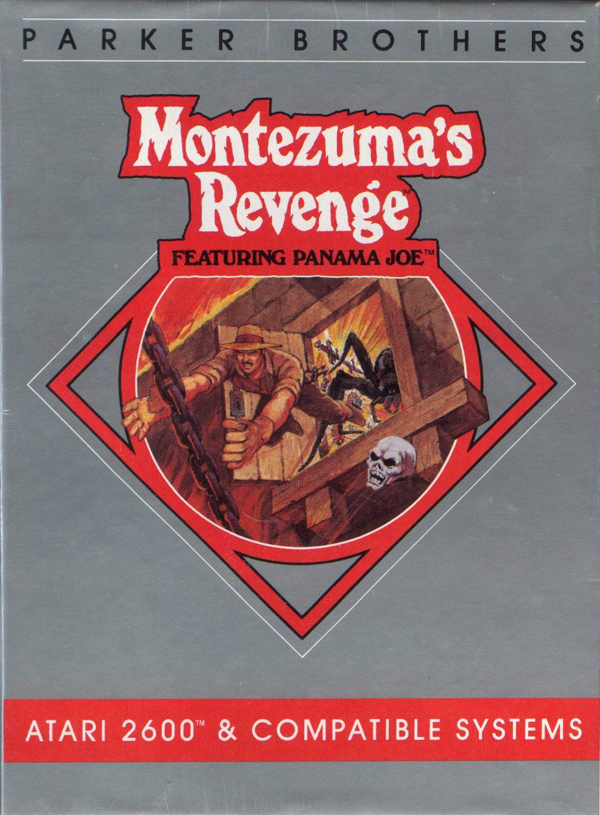 |
| Flagrant plagiarism!. |
Publisher/Designer: Parker Brothers
Release Date: 1984
Systems (played on): Atari 2600, Atari 5200, Apple II, Atari 8-bit, Commodore 64, ColecoVision, PC Booter, SEGA Master System
I'm going to be honest: I know very little about the Atari 2600. I was born in 1985, and by then the Atari 2600 was already a relic. The graphics were simple, the sound was almost non-existent, and the games were repetitive. Growing up, one of my neighbors had one: we rarely played it, and when we did we focused almost entirely on Combat for its fantastic multiplayer and occasionally took turns with Pitfall before getting bored and going back to NES. So, that out of the way, here's what I know about Montezuma's Revenge:
The game appears to have been released for a number of system, including Commodore 64, PC, Apple II, Atari 2600 and 5200, and the ZX Spectrum starting in 1984. There isn't a lot of information available online, but the manual for the 5200 and C64 release shows a 1984 date, along with a few Atari information sites confirming a 1984 date for the 2600 release. The Wikipedia article provide some brief notes on its development at the hands of 16 year old Robert Jaeger.
My first surprise when researching this game was the array of systems this was ported to: what I thought of as an obscure game was actually widely available. My second surprise was this game was actually pretty fun and surprisingly advanced compared to my conception of Atari 2600 games.
+(Parker+Bros)_2.png) |
| Each hat is a life. You will need all of them. |
Oh, sure, the difficulty is absurd. I barely made it off the first screen in the first few rounds of play. Everything provides a way to die: if you jump from too high off a rope to an adjacent platform, you will die. If you slip off the conveyor belts, you will die. If you touch an enemy, you will die. If you touch a laser, you will die. In retrospect, these are obvious, but modern games have spoiled me.
+(Parker+Bros)_6.png) |
| I really don't think the points are worth it. |
The amount of precise timing in this game is something I'm not used to. You can't tell from the screen shots, but that skull rolls around fast, and those blue lines are laser gates and leave little room for error. Luckily for the player, the protagonist, Panama Joe, is a zippy archaeologist and responds nicely to the controls.
+(Parker+Bros)_7.png) |
| This is how you enter this screen. If you don't stop moving as soon as you come down the ladder, you will be killed by the spider. Super harsh, Montezuma. |
Moving beyond the difficulty, this game certainly offers a lot of options. I've haven't been able to get far in this game: I've mapped a total of 9 screens, over maybe 50-60 lives and an hour. I haven't seen a torch or an amulet yet. According to the manual, with the exception of the torch, all of the items are single use. This is a standard game trope with keys, but is disappointing with the sword. Despite my disappointment at my lack of a more extensive and permanent inventory, I was impressed right away with the branching paths available! Furthermore, the game "remembers" what happened during your life. When you die, you quickly restart on the screen you were on, and enemies stay dead, doors stay opened, etc. I was expecting each death to reset the current screen, but luckily the game isn't that rough on the player.
That concludes the first hour or so of gameplay. I don't have a terrible passion to keep on playing it, but I'll continue to try and see what else it offers.
Sunday, July 15, 2012
Retroidvania Rules and Ratings
In order to keep this blog and myself sane I'll adopt some rules and ratings inspired by other blogs like this one.
Rules:
Like other blogs of this nature, I've made up my own rating system, with five categories rated from 1 - 10, leading to a grand score of 50.
And with that we move onto the first game, Montezuma's Revenge, something I never had heard of until putting the list together.
- Five hours or completion.
- No save states besides as a pause.
- No maps/walktroughs/hints until after completion.
- Follow the list.
Ratings:
- Visuals
- Audio
- Gameplay
- Metroidvania Quotient
- Set and Setting
And with that we move onto the first game, Montezuma's Revenge, something I never had heard of until putting the list together.
Subscribe to:
Posts (Atom)
Retroidvania

- Samus Belmont
- Portland, Oregon, United States
- I enjoy video-games and video-game accessories.